
iSlated

The power of words was demonstrated over the Christmas period by the fact that Apple’s share price rose by 1% on the rumour that they would be launching a new tablet device.

Interesting though the questions raised by this sudden surge might be, others can speak to those much better than I could.

I am more interested in how such a device might succeed.

Despite what you might think, building a tablet PC is not hard. The form factor is just an extension of something like an iPhone and a quick look on eBay will show you how many Chinese companies can build an iPhone lookalike. For an operating system, well something like the excellent Jolicloud would be a good place to start or perhaps Moblin. Moblin in particular cries out for a touchscreen interface.

You create a central webstore/data repository, possibly using Amazon S3 or perhaps even Azure. The Tablet then becomes a window onto the Cloud with a transparent mix of local and webapps providing the user with ubiquitous data access via Syncplicity style synchronisation.

Easy. If you are a VC or an angel investor then give me a shout 🙂

So if it is easy then why is the world waiting for Apple?

I can think of 3 “good” reasons.

Bitter Experience

I have used tablet computers – both small ones like the Nokia 810 and Windows Tablet Edition laptops. Whilst they had an appeal they never became my main computer and soon fell into disuse. Did they ever make a profit? How many companies got burnt as a result?

Apple has a history of disruptive technological change – perhaps they can overcome this bitter experience of users and industry alike.

Ecosystem

A tablet is nothing without its connections, it only has value as a window into a wider world. All computers are the same; your office PC is not a general purpose computer, it is a window into your corporate information and systems.

The iPhone Apps Store has created a vast and rapidly developing ecosystem which would be just right for a tablet. At the same time, the disruptive effect of the Web on all information and service intermediaries means that businesses are desperate for new business models which look as much as possible like their old business model.

Point

The last reason is the deepest of all. What is a tablet for? People start off by eulogizing the potential of such a device but then very quickly trail off. We geeks may want a device which allows us to read RSS feeds in the bath but the vast, sensible mass of humanity do not.

But what happens as a tool becomes more ubiquitous? Look at how the iPhone has changed not just the smartphone market but people’s expectations of what a smartphone should do.

If a tablet allows you to carry your life with you in a small, secure form then what effect will that have on our culture and society?

Like everyone else reading this I will be buying an iPlate/iSlate/iiiMoosey, but at least I know that I have no idea why!

For now I will stick with the one tablet I know and trust 🙂
5 “Shared Services” concepts I never want to see again

I like Shared Services, my first response to any business need is to look around for a service which can provide it, only if all else fails do I develop it myself.

And Shared Services offer the opportunity to work with like-minded partners who have similar business needs and where we can work together to drive up service levels and drive down costs.

So why do I too often groan when someone suggests a new “Shared Service” offering to me?

1. Economies of FAIL

Your Shared Service offering is more expensive on a per item basis so I will lose money on each transaction.” “Don’t worry, you’ll make it up on volume!!!

Economy of scale is a perfectly reasonable concept, tried and tested over the years, the marginal costs of delivery will tend to fall in line with the volume. However too many Shared Service offerings start out more expensive than a traditional offering and never reach the point where they are cheaper.

2. The Spanish Prisoner

Our Shared Service will save you money on each transaction, however there is just a small upfront fee to make use of the service…

Some Shared Services, particularly those based around a catalogue or framework, offer ease of use and a discounted rate but to get to use them you have to pay in advance.

This is a perfectly reasonable business model, provided it is the user’s business model it works for. If paying 5% of total costs up front will save me 10% then that is great.

Unfortunately a number of these Shared Service offerings are based on the supplier’s business model and paying 10% of total costs up front to save 5% is not a winning pitch!

3. The Incomprehensible

We promise to undercut any competitor and provide free biscuits for all users!

Now I understand business models, private sector firms are there to maximise shareholder value in the same way I am here to maximise taxpayer and societal value.

So why do people present me with Shared Service offerings which do not make economic sense for the supplier?

Sometimes this is a loss leader, well selling tins of baked beans at below wholesale prices is a loss leader, delivering a complex mission critical service should never be a loss leader!

Loss leaders also tend to have a sting in the tail, that remarkably cheap car which requires solid gold head gaskets or that MP3 player which can only be programmed in Linear B.

Sometimes it is down to perverse incentives – the sales team are incentivised to close the deal at any cost. I can think of at least one major outsourcing and ICT services firm which ended up being bought out by a rival for that very reason. Their sales team let a contract which netted them big bonuses but almost killed the company itself.

And sometimes it is down to the fact that the supplier simply does not understand the business model or they have forgotten something very obvious. Like the travel firm who spent a fortune on a new IT sales system which significantly increased business, unfortunately it was selling all holidays at cost so the more business it did the more money it lost!

4. Barry

Well it’s a new area for us but digital engagement is in many ways a lot like plumbing, and Barry does have his own van

I always welcome new players – entrepreneurs and SME’s in particular – getting involved in service delivery and new offerings.

But this strong support and engagement is not the same as “magical thinking”. If I am looking for someone to work with on a critical service then I expect professionalism.

That’s not about lots of barriers or red tape or people in suits. It’s about being able to trust partners to deliver. That is the key metric I judge service providers and partners on – be they multinationals or one man bands. I want to work with people who are delivery focused, committed to quality and success and who are as committed as I am to excellence, customer service and proper engagement.

5. Unclear Objectives

And whilst window cleaning will continue to be at the core of this Shared Services offering, we are pleased to announce that we are bringing in nuclear waste recycling services as well.

Good services grow and develop over time, this is how it should be. But too many Shared Services start from the premise that their window cleaning service will automatically become all encompassing.

I am not in the business of subsidising other people’s plans for world domination, #evilCIO has his own plans!

Focus on making the core service a success and growth will follow organically.

ReRewired

I was one of the judges at Young Rewired State this weekend. The event brought some 50 15-18 year olds together to work on taking public sector data and websites and making it relevant to them.

I was not quite sure what to expect. I cannot remember anything about being 15, and the world has changed greatly since then. This “fire” stuff for one.

What I was presented with (often expertly) was a range of exciting and occassionally transformational projects. You can find a list of all the projects here.

Whilst there was a vast amount to digest, after much thought three things in particular stand out for me about Young Rewired State.

The Reflecting Surface

What would happen if we were to hold a State Rewired State event? That is, what if we were to get a group of frontline staff, users, internal and external geeks, suppliers and data owners together for a 2 day event looking at say education or benefits? Would this help trigger internal innovation, build bridges between various communities and identify some quick wins?

Internal hackdays have been used by a number of organizations in the past, based on informal feedback there seems to be a real appetite for doing something along these lines in my daytime world. So time for me to talk to my CIO Council colleagues.

“Let their hand go for it,  grasp it”

How do these ideas get taken forward? At least one of them struck me as having real value and being an interesting thing to build on. So how do we do that? Do we leave it to the VC’s and angels or do we intervene, and if so how?

Take 1

We are at the very start of the mashup process. Some of the entries were blindingly obvious in retrospect but the fact that no one had done it before was a very sobering realisation.

It is also clear that we have yet to think through the implications of mashups. Perhaps surprisingly for a CIO, I am very uncomfortable with the cybernetic theory of government, that somehow perfect information will allow perfect decision making. 

That was one of the reasons why Blog-o-tics was so interesting to me, the idea of being able to gauge views on policy initiatives at a glance is very appealing, but how do we avoid ending up here?

Anyway, looking forward to the next round of Rewired State and discussing next steps with the CIO Council next month.

Hotter than heat

It is hot. 25C according to my thermometer, though it feels hotter than that to me as I have a fever at the moment. I pulled a muscle in my arm and my body has ramped up my metabolism to repair it, hence the fever.

I can think of at least one friend who will laugh at loud at the concept of 25C being hot!  To them 25C is barely warm.

We all respond to heat differently but we all live in the human heat range, which is between –40C and +40C. It may be slightly warmer or colder at times but the vast majority of our existence is spent in that 80 degree range.

The coldest possible temperature is Absolute Zero, –273.15C. or 0 degrees Kelvin. The hottest possible temperature under physical laws as we currently understand them is the Planck temperature or 1.41679 x 10^32 degrees Kelvin.

So we humans live at 273 degrees Kelvin +/- 40 degrees Kelvin. Or 0.000000000000000000000000000001% of the range between lowest and highest temperatures. And right down at the bottom, frozen end.

Which makes sense because we are made of matter and matter is just chilly energy :).

So given that we occupy such a small range of possible temperatures, right down at the cool end of the spectrum why am I so hot?!

The Speed of Language

As I drifted off to sleep the other night I found myself reminded of Yakko Warner’s attempt to sing all the words in the English language.

So how long would it take to actually sing all the words in the English language? Well, there is no definitive number of words in the English language, it is somewhere between 500,000 and 2 million once you include regional and specialist words.

So let’s go for 1.2 million as a sustainable compromise figure. So if it takes an average of 1 second per word, singing 1.2 million nonstop would take about 14 days.

So you, or more likely a robot, could reach the end of the English language in 14 days. But would you? Or are new words created so fast that you would never reach the end?

What is the speed of language? I have a mental picture of a little car, driven of course by a bear, speeding down a road made up of words at 1 word per second. Does the bear ever reach the end?

What speed does the bear need to travel at to reach the end? How vast would the language be to require the bear to drive at the speed of light?

And which is the fastest language?

These are the things which occupy my mind as I fall asleep. Pity me.

2029 part 1

Two key points before we start – the first is that anyone who tries to forecast the future is doomed and the second is that nothing here should be taken as having any official status at all. This is me thinking aloud

With that out of the way, here are some idle thoughts on the implications of technology as a driver of social change over the next couple of decades.

The Commercial Property Market is doomed

See those big office blocks? Why do they exist? Because the work done by the organization requires people to be closely colocated? Because the resources they need are in one place? Because it is more efficient?

In most cases none of those are true today and definitely not in 2029. Anyone who has ever worked in a corporate environment knows that there are only 3 things needed to work –  information, tools and people.

Information used to mean paper files – vast acres of boxfile plantations filling the land. But now information means a search engine and a memory stick.

Tools used to mean filing clerks, huge mainframe computers and typists. Now tools mean a laptop and wifi.

People used to mean … well what did people mean? Performance management was performance observation, serried ranks of people meant a diary full of update meetings and make work meetings. Think about how often you actually need to talk to people at work for real work related purposes, how many people you actually need to talk to and how many times it wouldn’t have just been easier to call, email or Tweet them?

Half the people reading this post will think it is obvious, they do not have offices or they just use short term touchdown or shared space. The other half will say that they are obviously looking at things like “hotdesking” to reduce demand for office space, but without challenging the essential concept of the office.

For most organizations, accommodation is the second biggest item of corporate expenditure after staff. Why are we spending that money? How long can we afford to spend that money?!

The HQ office is sacrosanct, we need those marble halls. It is a visible symbol of our corporate strength.

The office building is a dinosaur, it is like the battleship of a century ago, staggering onwards because of ego, tradition and self-interest. But like all dinosaurs, it is doomed.

Not all offices will go of course, they will survive in schools, universities, hospitals – anywhere where the purpose is either to work with people or, like museums, to work with objects.

But the general purpose office which makes up so much of any city landscape cannot survive.

So what happens to Canary Wharf? What happens to the revenues from rates and the jobs in supporting these land leviathans?

Good questions.

The city is a beach

What will the world be like when you can just look at an object and find out what it is? When you can change how you see the outside world so beggars or the poor never appear in your line of sight? When we are continuously wired?

So far we have separated World 1 – the real world, and World 2 – the online world but we are now starting to overlay them to create World 1.5 – the hybrid world.

Take something like Google Streetview – it’s an online representation of the real world overlaid with digital information. At the moment it sits on a computer screen but the next step is for computer screens to merge with glasses. So far, so old school cyberpunk but we can already see the first steps with iPhone apps that display information over live video feeds of your surroundings.

These feel clunky but what if it is in your glasses? Your contact lenses? A constantly updated reversioning of what you see. The glowing line that links you to your destination, continually adjusting to show you the way to go. The obscuring of sights you do not want to see. The ability to “Bing-o” anyone you see.

World 1.5 becomes a way of either seeing more clearly or, more likely, not seeing at all.

“Le silence éternel des espaces infinis m’effraie”

The rain runs down the window, trying but failing to obscure the gaudy lights flickering like ignis fatui above the blackened heart of the brooding city outside.

As I reach for the coffee cup, my hand trembling slightly, I watch the small people on the screen. People speaking words I have spoken, adrift in the same deep dark waters that lap around me; lost souls in a city of lost hope.

And my head fills with thoughts of my mad wonderful genius friend and her amazing films and her excellent book. (Recommended by CNN :))

And then I put on my hat and go off in search of the occluded secrets of the Capitale de la Douleur

Ever Decreasing Circles

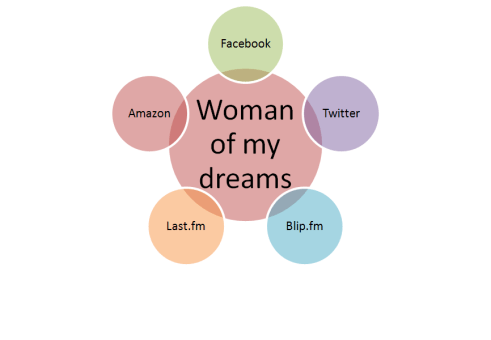
We were talking the other night about the power of social networks to connect us with people of similar interests. Through Facebook and Twitter we can gravitate towards elective affinities. No longer are we limited by location or access to just the people round us, we can find people who have similar tastes, similar interests, similar names anywhere in World 2.0.

Someone then asked what happens at the intersection of these social networks?

We are all faceted individuals, we all can tell rueful stories of what happened when one group of our friends met another group for the first time. So the overlap between these spaces may be limited, so the set of people who belong to the intersection of all the social sets we belong to will tend towards 1. Ourselves.

But what happens when we meet someone else in this hyperelective affinity? Are they our soulmate?

A nice thought. But then again I wonder if we lose something in such a reductive process? I am much the wiser for having friends who are very different from me. That tension between planning and experience. Perhaps there is another way?

She probably lives in Tahiti

Big Blue World

Was at City University last night to see Thomas Gensemer, Managing Partner at Blue State Digital, talk about the use of social media as an engagement tool based on their experience running that strand of the Obama campaign.

I have to say that I was very taken by his approach. I was expecting something more technology focused, buzzword laden but instead the focus was very much on using simple technologies to build on basic good comms practice.

Some things I took away from the talk:

1. Be clear about why you are communicating. Do you expect the recipient to do something as a result? If so what? How will you know? How are you supporting them to achieve that? How does this become an engagement as opposed to just a one off?

2. Scale can be a way of derisking engagement. With 10 people if 2 disagree with you then that’s 20% of the audience actively against you, with 10 million people then even if 10,000 disagree with you it does not have the same impact.

3. If you are going to use technology then be clear why that platform. If the core value to you is being able to data mine the information about the people you are engaging with then doing that through Facebook or Bebo just means you have gifted that information to the platform owner. Not only that but you are now entangled in their brand values, viz. recent Facebook change of terms controversy.

4. Email works. Not email newsletters, no one reads them unless they are very specialised and effectively fanzines, but clear short emails which link to useful things. How can I get involved? What are the next steps? What resources are available to me? I liked the line about how the energy spent on email newsletters is vast and the return so slight.

5. Trust the people. User generated content can be gold. A recording of a teacher, a film of a volunteer these were the powerful things that stick in the mind.

6. But don’t get captured. It’s about facilitating community engagement, not community diktat. Be clear, be brave, don’t just delete and hide from things which challenge or embarrass but also do not get captured. Be clear what is up for discussion and what is settled.

7. Make it real and make it tangible. “I clicked here and I did this and now I am making this difference.”

None of this is unexpected, none of it rocket science so why are we still hooked on the idea that if we provide a platform that somehow, automagically, a topic will become interesting and people will become engaged?

Oh and

More Selective

I am a big fan of Last.fm. It has introduced me to music that I would not otherwise have come across and it has basically replaced all but Radio 3 in terms of music stations for me.

While listening to it the other day my eye was caught by two statistics which Last.fm gives you about artists – the number of listeners and the number of tracks played. So Pylon who are playing in the background at the moment have 117,314 plays from 10,673 listeners, giving a ratio of nearly 11 plays per listener. This got me wondering about how this compared to the wider world. 

Obviously the baseline is a  band which has just one play and one listener. Hmm, I think I might have seen them supporting Boots for Dancing. So the lowest you can go is 1.

Now you could have an obsessional fan who only plays ooh The Prats and does so day in, day out so you could get a very high ratio without it meaning anything so there should be a landscape where you want a high ratio but not too high, lots of plays and lots of listeners.

So what does my world look like?

Biosphere 17.96
Brian Eno 19.57
Ferenc 4.53
Lali Puna 15.31
Loscil 11.80
Pan American 10.54
Pylon 10.99
Talking Heads 18.89
Wire 17.82

So apart from Ferenc they all sit between 10 and 20.

But what about “popular” bands, what do they look like?

Well Coldplay have a ratio of 48.80, Girls Aloud 23.74 and The Killers 40.98. So does this mean that Mark does not like any music which scores over 20? Well Interpol hit 41.42 so nope.

So does this mean anything or is it just an exercise in stats? No idea, just a way to kickstart my brain this fine new year.

Oh and The Prats? 3.62.